About & the Book

Observe, Think, ActStrategic Leadership in the Age of AI

by Risto Siilasmaa

Four parts

How the book is built

Part I

The Anatomy of Failure — Why we fail

Starts with the individual. Why do capable people and organisations make consequential mistakes that, in hindsight, seem avoidable? The aim is to understand where the Observe–Think–Act loop breaks.

  1. Ch 1 · The Questions Not Asked
  2. Ch 2 · Observe: Seeing Reality Before the Crowd Does
  3. Ch 3 · Think: From Signals to Models
  4. Ch 4 · Act: Turning Insight into Momentum
  5. Ch 5 · The OTA Flywheel

Part II

The Coherent Organisation — How to get better

Turns diagnosis into practice, introducing concrete tools for strengthening Observe, Think, and Act, one muscle at a time. Most can be put to work immediately.

  1. Ch 6 · Training Observation: Building a Personal and Organisational Radar
  2. Ch 7 · Training Thinking: Breaking Down Bias, Mental Models and Probabilistic Discipline
  3. Ch 8 · Training Action: Execution That Learns

Part III

The Compounding Learning Loop — Making it work at scale

Changes the level of analysis from the individual to the organisation: how the pieces fit together at scale, what the OTA 200 shows across the 15-cell grid, and where even a strong Toolkit still leaves vulnerabilities.

  1. Ch 9 · The Architecture of Failure
  2. Ch 10 · The Six Pathogens
  3. Ch 11 · Embedding OTA in the Organisation
  4. Ch 12 · The Five Modalities: Mapping Organisational Health

Part IV

Beyond Human Speed — What AI changes

Asks what becomes possible when AI is added to the same system — not simply faster tools, but Observe, Think, and Act built into a continuous learning system operating at scale. Same OTA system, new engine.

  1. Ch 13 · Adding the Engine
  2. Ch 14 · AI as Observation Amplifier: The New Nervous System
  3. Ch 15 · AI as Thinking Amplifier: The Continuous Challenge
  4. Ch 16 · AI as Action Amplifier: Execution That Remembers
  5. Ch 17 · Seeing Clearly at Machine Speed

Maps of the book

Three figures from the book

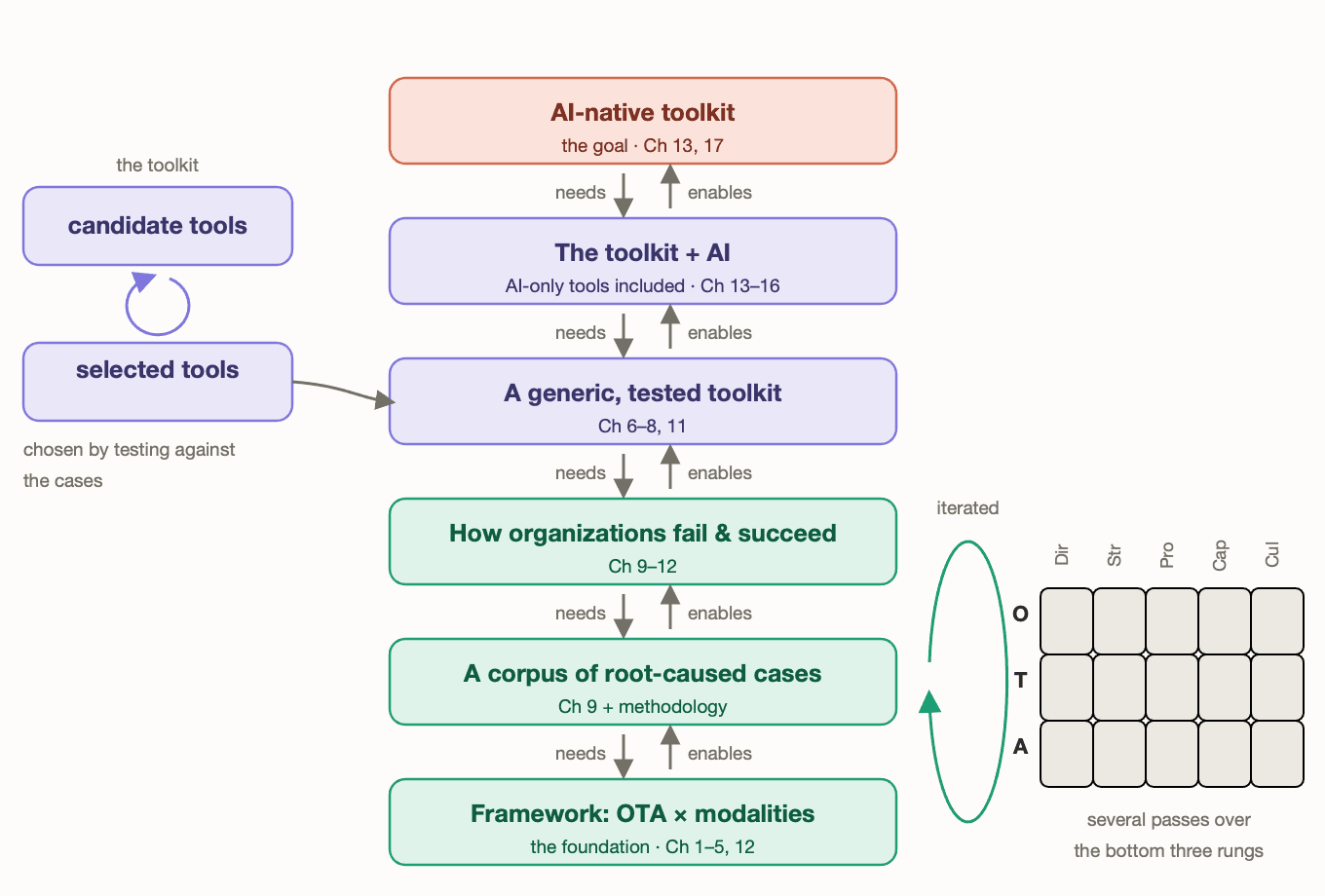
The book builds a framework, tests it against two hundred real cases, derives a Toolkit from what the cases show, and then asks what changes when AI becomes a native part of the organisation. These figures show that structure.

The logic of the book

A six-rung ladder, each rung needing the one below and enabling the one above. From the bottom: Framework: OTA × modalities (the foundation, Chapters 1–5 and 12); a corpus of root-caused cases (Chapter 9 and the methodology); how organisations fail and succeed (Chapters 9–12); a generic, tested toolkit (Chapters 6–8 and 11); the toolkit plus AI (Chapters 13–16); and the AI-native toolkit (the goal, Chapters 13 and 17). Beside the bottom three rungs, a 3 × 5 grid of Observe, Think and Act against the five modalities, iterated over several passes. Beside the toolkit rung, candidate tools are selected by testing them against the cases.
From framework to cases to a tested Toolkit, and then to what AI changes. The bottom three rungs were iterated several times against the OTA × modalities grid.

A map of the book

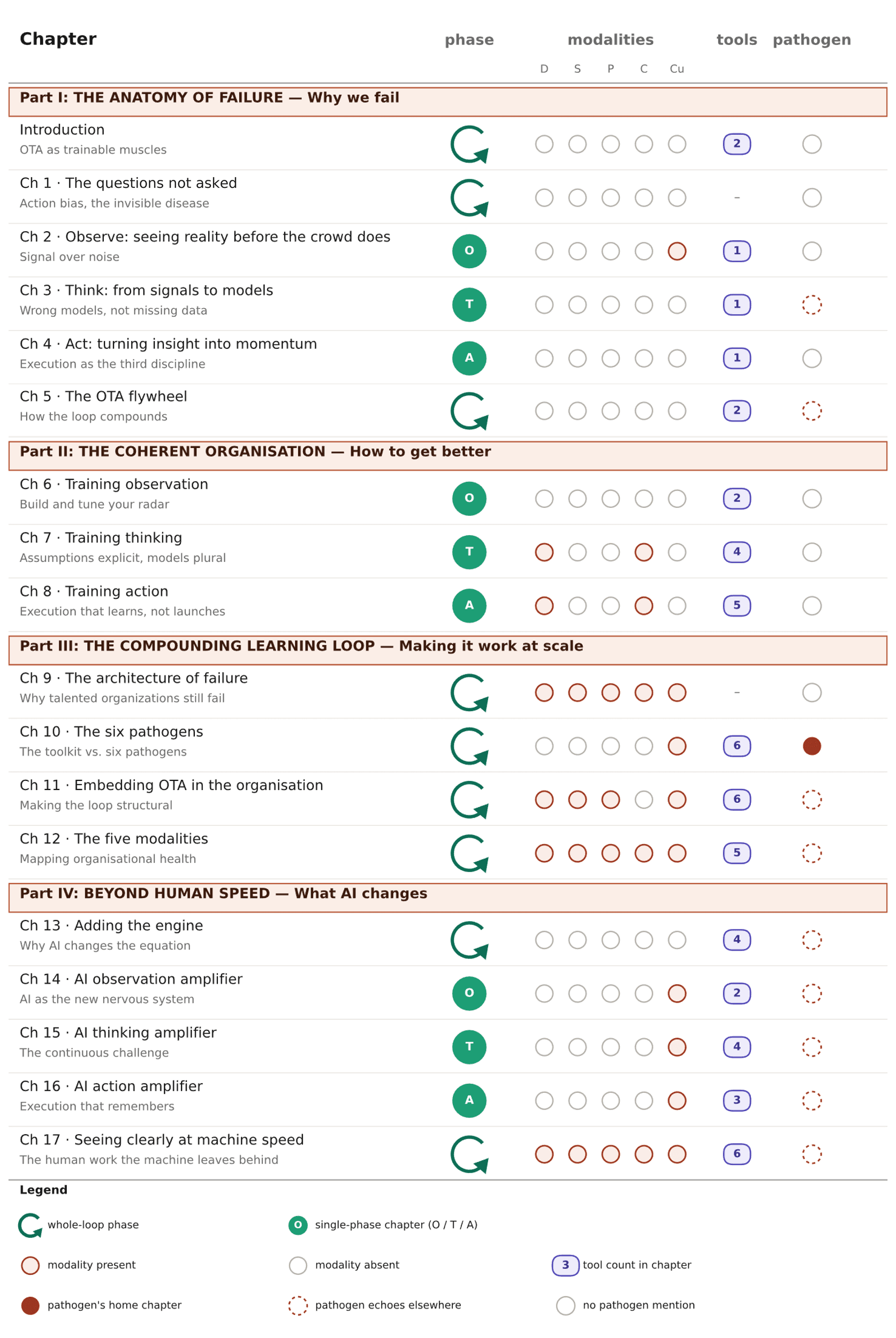
A chapter-by-chapter table for all four parts. For each chapter it shows whether it covers the whole OTA loop or a single phase (Observe, Think or Act), which of the five modalities it addresses, how many tools it introduces, and whether it is a pathogen's home chapter or only echoes the pathogens.
Each chapter's phase, modalities, tool count and pathogen coverage — a way to regain the bird's-eye view if you get lost in the details.

The detailed map, at the end of Part III
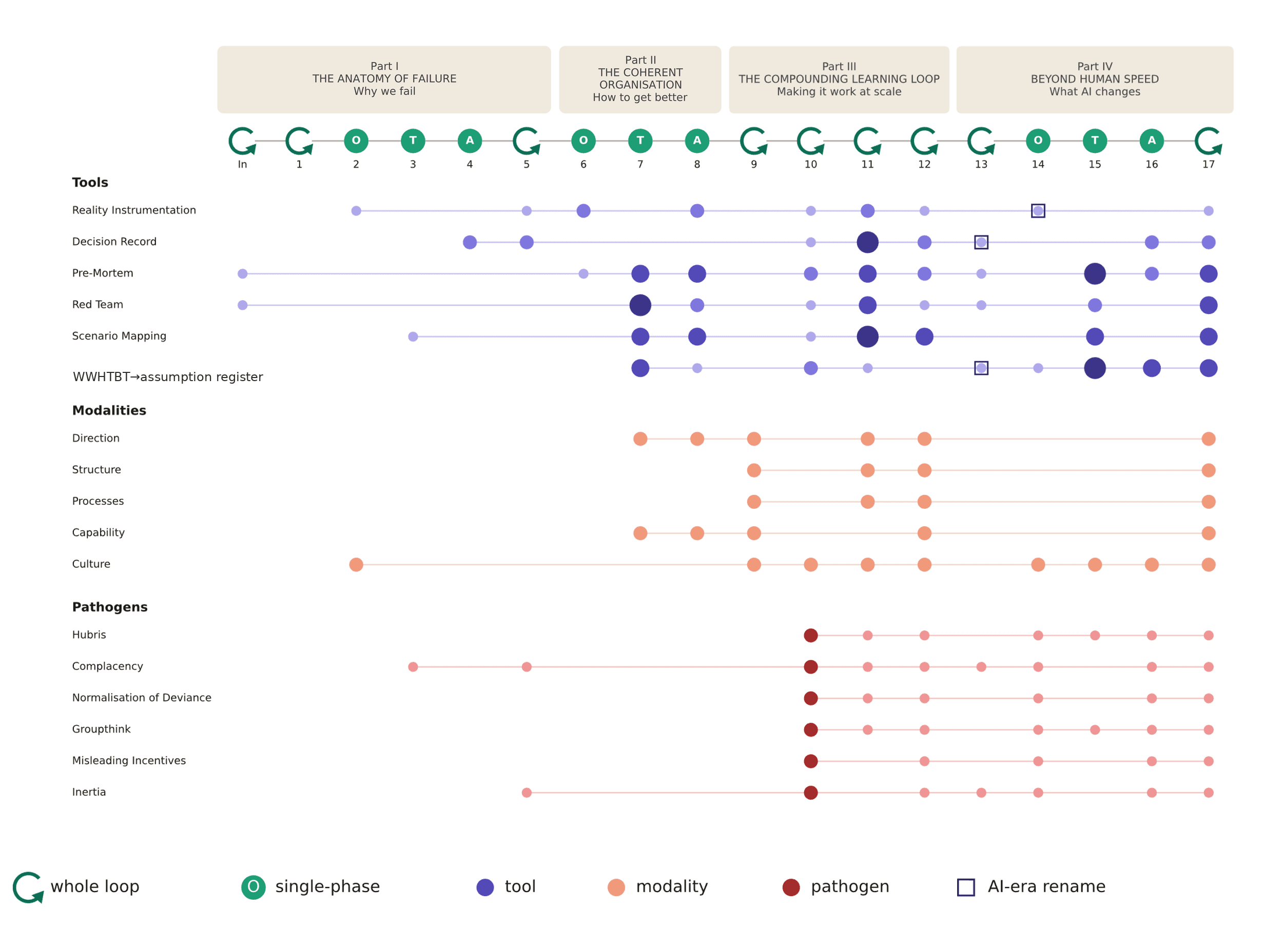
A timeline across the Introduction and Chapters 1–17, grouped into the four parts. Rows trace where each tool (Reality Instrumentation, Decision Record, Pre-Mortem, Red Team, Scenario Mapping, and WWHTBT feeding the assumption register), each of the five modalities, and each of the six pathogens appears, with larger dots where a chapter treats it in depth and squares marking where a tool takes its AI-era form.
Where each tool, modality and pathogen appears across the book — and where a tool takes its AI-era form in Part IV.

Where can I get the book?

On publication

Retailer, format, and translation links will appear here on publication. Until then, the update signal below is the best way to hear when the book is available.

In Finnish

Havainnoi, ajattele, toimi – Strateginen johtaminen tekoälyn aikakaudella -kirja julkaistaan 17.11. Teoksen kustantaja on Tammi.

The Finnish edition is published on 17 November by Tammi.

Hardcover — comingE-book — comingAudiobook — coming

Get updates

A short digest, not a newsletter

A note when something real changes: publication news, corpus updates, new corrections.

About the author

Kept short on purpose

Risto Siilasmaa founded F-Secure, chaired it for over three decades, and chaired Nokia through its 2012–2020 transformation — a decade of sitting where the OTA loop either runs or breaks. Observe, Think, Act is his attempt to turn that experience, tested against two hundred scored cases, into something other leaders can use.

The shortest way to understand his argument is not this paragraph — it is the framework and the research behind it.