The Framework
One loop, five modalities.
The framework is small enough to hold in your head and specific enough to score two hundred real cases against. An organisation observes, thinks, and acts — continuously. Five modalities determine how well each phase runs. Everything else in the book, including the toolkit, builds on this.
The framework at a glance
Twelve ideas to remember
- 01
Agency
The capacity to stay aligned with reality, make sense of what it implies, and intervene with intent ahead of events. Observe, Think, Act is the operating system of agency.
- 02
The OTA loop
Observe, Think, Act — three phases run continuously. The flywheel of Chapter 5 is the metaphor for how repeated loops compound learning; it is the same loop, not a second framework.
- 03
Paranoid optimism
Paranoid enough to look for everything that can go wrong; optimistic enough to believe that knowing it puts you ahead of those who refuse to look.
- 04
The OTA 200
The empirical foundation: 200 companies, 100 failures and 100 successes, scored against the same 15-cell grid.
- 05
Five Modalities / OTA × modalities grid
Direction, Structure, Processes, Capability, and Culture, crossed with the three phases into a 15-cell diagnostic map of where failure and success concentrate.
- 06
Six Pathogens
Hubris, Complacency, Normalisation of Deviance, Groupthink, Misleading Incentives, and Inertia — the diseases that arrive with success and infect the loop from within.
- 07
The Toolkit
The leader's working repertoire for training Observe, Think, and Act. In Part IV the same tools gain a new engine; they are not replaced by a second toolkit.
- 08
Scenario Mapping
Keeps several plausible futures alive, with leading indicators for each branch. With AI, the same practice becomes continuous.
- 09
Decision Record→ Decision Ledger
One document opened before a commitment and closed after it — which, with AI, becomes a shared, queryable record every other tool reads from and writes to.
- 10
Reality Instrumentation→ Reality Lattice
Pointing the organisation's instruments at strategically relevant reality — which, with AI, becomes a continuous observation layer beyond human processing capacity.
- 11
Red Team→ Adversarial Engine
A designated challenger building the strongest counter-case — which, with AI, becomes continuous challenge with no status, ego, or career risk.
- 12
Decision Architecture→ Autonomy Ladder
The map of which decisions live at which level. The Autonomy Ladder is the governance mechanism within it through which AI earns, holds, and loses decision authority.
The OTA loop
Three phases, continuously
Most organizational failure looks, from the inside, like decisive leadership: meetings held, decisions signed, contracts executed. The book calls this the illusion of action — motion mistaken for progress. Speed is not the same as velocity. Speed means moving fast; velocity means moving fast in a direction that stays correct as reality changes. The Observe-Think-Act loop is the mechanism that keeps velocity honest, and it runs as three overlapping, continuously-informing phases rather than a start-to-finish sequence.
Observe is an active discipline, not passive awareness — building sensing systems that catch weak signals while they’re still deniable, not just consuming more information. Kodak’s leadership saw the digital-imaging transition coming in 1975 and forecast its timeline correctly in 1979; Observe was never where Kodak’s failure lived.
Think is where signals become an interpretive model — and models, once formed, become invisible: indistinguishable from “the way things are.” This is where Kodak actually failed: it saw digital coming and reasoned its way into believing the transition would stay slow enough to manage on film’s own timetable.
Act is the discipline of committing — resources, reputation, time — to a chosen course, and accepting that reality will prove you right or wrong. Most organisations mistake constant motion (meetings, pilots, reorganisations) for action; real action is a falsifiable bet.
None of the three works alone. Failure in any one collapses the agency the other two were building. The rest of the book — and the toolkit — exists to strengthen the loop that runs all three together, continuously.
Observe
Does the organisation see reality clearly and early — and does the signal reach the people who reason about it?
Think
Given the signal, does the organisation reason toward the right interpretive frame — or preserve the frame it already has?
Act
Given the reasoning, does the organisation execute — decisively, competently, and in time to matter?
One loop, two hundred organisations
The framework above isn’t built from one story. It’s scored against two hundred real cases — Nokia’s smartphone platform collapse, Boeing’s 737 MAX, Theranos, Enron, GE’s Alstom bet, Yahoo’s twice-missed Google acquisition, and many others, alongside a hundred organisations that got it right. Kodak is the worked example below because it isolates one phase so cleanly — but it’s one case among two hundred, not the exception the framework was built to explain. Browse the full corpus →
The loop, applied to one caseKodak, 1975–2012
In 1972, Roger Van Heyningen, director of the Physics Division at Kodak Research Laboratories, set up a small laboratory to explore electronic imaging. In 1979, Kodak's Larry Matteson forecast that imaging would shift from film to digital — first in government, then professional applications, and eventually the mass market — with the transition essentially complete by 2010. He was remarkably close. Kodak did not fail to see the future. It saw it decades in advance. The harder failure was acting on what it saw: the economics, incentives and decision processes of a company built around film repeatedly made the emerging digital business look less attractive than the business it threatened to replace.
Kodak is the worked example because one phase so clearly carried the outcome — and it is the one people usually get backwards: the company did not fail to see the digital transition coming.
In the study, Kodak’s Observe phase is scored Hard-Correct and carries 0% of the causal weight — it performed admirably and did not cause the outcome. Think carries 100%, classified Easy-Wrong: the interpretive frame needed was available and was not applied. The primary modality is Culture.
Read the full scored case →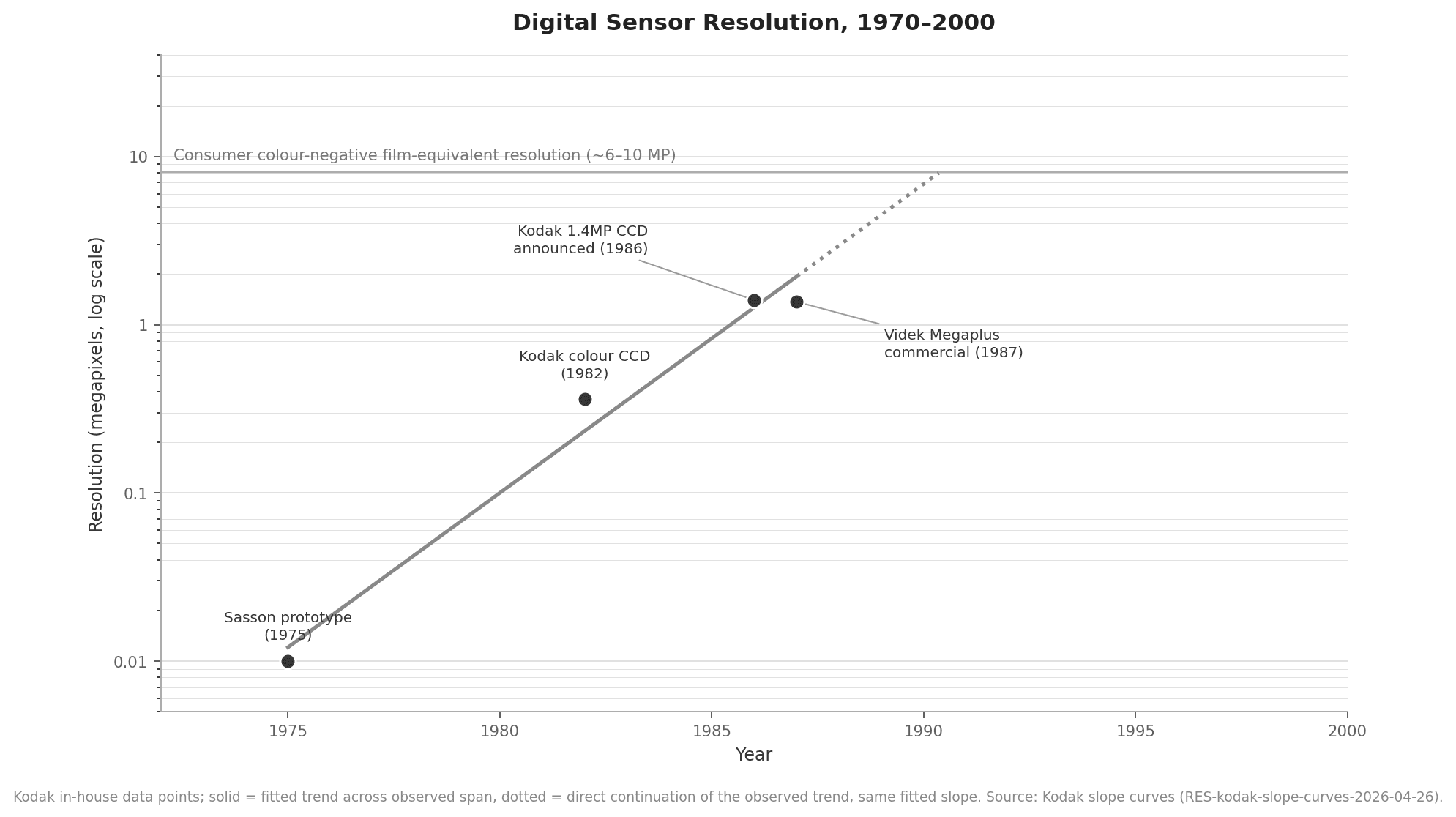
- 1975ObserveSteven Sasson builds the first self-contained digital still camera in Kodak's Rochester laboratories.
- 1981ObserveThe Barabba market-intelligence study forecasts digital displacing film, with roughly a ten-year runway. It reaches senior leadership.
- 1994ThinkFisher creates the Digital and Applied Imaging division — formally separated, but left dependent on the film organisation's goodwill.
- 1996ThinkAPS/Advantix launches: more than $500m committed to a hybrid film-plus-digital-index format, extending film rather than replacing it.
- 2003ThinkPerez anchors the successor thesis on a consumer-inkjet razor-and-blade model, reasoning from an HP analogy.
- 2007ActSmartphones absorb the consumer camera category; digital-camera margins compress.
- 2012ActChapter 11 on 19 January: $6.75bn of debt against $5.1bn of assets. The core digital-imaging patent portfolio sells for $525m.
The five modalities
How each phase runs
- Direction
- The strategic choices an organisation makes — where it decides to go, and the dated, attributable decisions that commit it.
- Structure
- The architecture of authority and reporting — who is positioned to act, with what independence and what resources.
- Processes
- The machinery — planning cycles, coordination procedures, capital allocation — that turns intent into repeatable action.
- Capability
- The skills, assets, and competences the organisation carries — and whether they match what the situation requires.
- Culture
- The collective norms and reflexes that outlast any individual leader — and quietly decide what the other four are allowed to do.
The OTA × modalities grid
Three phases × five modalities
| Direction | Structure | Processes | Capability | Culture | |
|---|---|---|---|---|---|
| Observe | Observe × Direction | Observe × Structure | Observe × Processes | Observe × Capability | Observe × Culture |
| Think | Think × Direction | Think × Structure | Think × Processes | Think × Capability | Think × Culture |
| Act | Act × Direction | Act × Structure | Act × Processes | Act × Capability | Act × Culture |
The book walks the grid cell by cell. The study shows what two hundred organisations look like when you actually fill it in.
What the grid keeps showing
Three concentrations, one asymmetry
Where the data concentrates
The Think × Direction concentration
The most consequential cell in the entire grid is Think × Direction — where the quality of strategic reasoning meets the question of where the organisation is going. It carries about 20% of non-fraudulent failure weight and 18% of success weight, the peak cell in both cohorts. Same cell, different content. In failure, it is a leadership team with a confident, sophisticated model of how the industry works, applied where it no longer fits (JCPenney under Ron Johnson: a brilliant model of retail psychology, deployed in an environment that rejected it). In success, it is a leadership team whose model proves a more accurate read of the industry’s evolution than its competitors’ (Netflix holding two incompatible business models through the 2007–2012 transition; TSMC keeping its foundry-neutrality model against industry consensus).
The Direction column
The full Direction column, across all three OTA phases, is the grid’s central empirical fact: it carries 28% of non-fraudulent failure weight and 39% of success weight. The same column that makes an organisation succeed can make it fail when the disciplines that keep direction accurate are abandoned. Polaroid’s engineers saw digital photography coming — the failure wasn’t observation, it was a model (“digital will complement prints, not replace them”) that observation could not change. Amazon’s direction strength came from the opposite practice: returning to the same question — does our direction still serve the model? — as each new bet arrived, from third-party sellers to AWS to Prime. Direction strength is not a single correct insight but a model kept under examination as evidence changes.
Culture in the OTA 200
Culture is the most asymmetric modality in the grid. It is the primary modality in 90% of fraudulent failure cases, versus 8% of success cases; in non-fraudulent failures it drops to 31%, behind Direction at 41%. Culture kills but doesn’t save. Boeing’s engineers eventually accepted the 737 MAX plan, Volkswagen’s engineers understood what the defeat device was doing, Wells Fargo’s branch staff knew the account-opening targets were generating fraud — in every case the information existed, and the people who had it made a rational calculation that the cost of speaking exceeded the cost of silence. The useful question is not “is our culture a competitive advantage?” but “are cultural conditions putting us at disproportionate risk?”
Core finding
The asymmetry between failure and success
Success and failure are not mirror images, and the study scores them with two different questions because of it. Failure cases ask what caused the outcome to go wrong — weight follows causation backward. Success cases ask what distinguished this organisation from a reasonably-resourced peer — weight follows the contribution that made the difference. The same correctly-executed phase that carries zero in a failure case can carry the majority of the weight in a success case. Treating the two symmetrically is itself a reasoning error, and it is why the self-assessment below runs two separate tracks.
Concretely: Capability carries roughly 20% of success weight but only about 2% of failure weight — it saves but rarely kills — while Culture is close to the mirror image, dominating roughly 49% of failure cases against just 8% of success cases. Prevention and success-building are structurally different work; you cannot fully outsource one to the other.
Concepts that travel with the tools
Not tools themselves
- Calibration
- WWHTBT
- Psychological safety
- Paranoid optimism
- Calibrated trust
- Triangulation
- Reversibility
- Layered rollout
Score your own organisation
The way an OTA-200 rater scores a real case
“The two case types ask fundamentally different questions. Failure cases apply root-cause analysis: the scoring asks which phase or phases caused the outcome to go wrong, and weight follows causation backward from the failure. … Success cases apply differentiation analysis: the scoring asks which phase or phases distinguished this organisation from a reasonably-resourced peer that would have done less well, and weight follows the contribution that made the difference.”OTA Scoring Methodology v4, §1
What is the core reason your organisation could have an extraordinary future success?
Allocation 1 of 2
Divide 100 points across the phases
Which phase of the loop would be most differentiating? Drag the point, click anywhere in the triangle, or use the +/− controls.
- Observe.
- The organisation's perception of its environment: competitors, customers, technology shifts, regulatory change, and its own internal state.
- Think.
- The organisation's internal reasoning about what its observation implied and what it should do in response.
- Act.
- The organisation's external actions taken on the basis of that reasoning: announcements, investments, reorganisations, product launches, disposals, hires, cuts.
Allocation 2 of 2
Pick three modalities, then divide 100 points
Identify the main differentiator — what set this company apart from peers who never became great successes.
Select 3 more (0 of 3 chosen).
“Each case is scored along five modalities. Modality percentages sum to 100 per cent per case. No case is scored along more than three modalities at once; the other two are recorded as zero. Weights use 5-percentage-point increments with a 10 per cent floor on any non-zero modality.”OTA Scoring Methodology v4, §3
Select three modalities to continue.